
What Is the MCP Server in Dynamics 365 Finance & Operations
Over the last few years, Microsoft has talked extensively about AI in Dynamics 365. Copilot, intelligent insights, automation, and more recently, agentic AI. But for many Finance & Operations customers, the question remains the same: what does this actually m
Over the last few years, Microsoft has talked extensively about AI in Dynamics 365. Copilot, intelligent insights, automation, and more recently, agentic AI. But for many Finance & Operations customers, the question remains the same: what does this actually mean for my ERP?
With the general availability of the Dynamics 365 ERP Model Context Protocol (MCP), Microsoft has taken a meaningful step toward answering that question.
First, What Is the Model Context Protocol?
The Model Context Protocol, or MCP, is an open standard designed to allow AI agents to interact with software systems in a structured, secure, and governed way. Rather than building custom, one-off integrations for every AI scenario, MCP provides a consistent framework that lets AI models understand what data and actions are available, how to access them, and what rules must be respected along the way.
Anthropic describes MCP as a way to safely connect AI models to tools, data, and services without hardcoding brittle logic or bypassing security controls. The goal is not uncontrolled automation — it is controlled, explainable, and auditable interaction.
Why Microsoft Is Bringing MCP into Finance & Operations
Dynamics 365 Finance & Operations sits at the core of many organizations. By implementing MCP directly within Finance & Operations, Microsoft is enabling AI agents to interact with ERP data and business logic through governed interfaces — rather than through screen scraping, custom scripts, or fragile UI-based automation.
What the MCP Server Actually Enables
At a practical level, the Dynamics 365 ERP MCP Server allows AI agents to read ERP data, reason over that data, and act on ERP business logic — while enforcing the same security roles, permissions, and legal entity boundaries that apply to human users.
With the release of Dynamics 365 Finance & Operations version 10.0.47, Microsoft announced the general availability of the MCP Server for production use. Microsoft expanded MCP capabilities by introducing Data tools that allow standard create, read, update, and delete operations to be performed directly against data entities. Collectively, MCP tools now expose over 650,000 operations across the Dynamics 365 ERP suite.
What MCP Looks Like in Practice
An onboarding manager can ask an MCP-enabled assistant "Where are new customers getting stuck?" — the assistant can review onboarding status across systems, identify common delays, and summarize trends, all while safely accessing each system's data without bypassing permissions.
A Dynamics 365 administrator investigating why certain vendor invoices are not posting can review invoice status, workflow history, vendor setup, and posting validations in one place — with the assistant only accessing data the admin is authorized to see.
Why This Matters as Dynamics 365 Evolves
The introduction of the MCP Server signals where Microsoft is taking Dynamics 365. Future capabilities will increasingly assume that systems can be interacted with programmatically, intelligently, and contextually. This means less reliance on fragile UI-based automation, more consistent and governed access to ERP capabilities, and better alignment between AI innovation and enterprise control.
How TheTestMart Is Thinking About MCP
From TheTestMart's perspective, MCP is not just an AI story — it is a quality and trust story. As ERP systems become more intelligent and more autonomous, MCP changes how interactions happen, but it does not remove the need to validate business processes, data integrity, security boundaries, and end-to-end outcomes. We see MCP as an important step toward a more capable ERP platform, and one that reinforces the need for thoughtful testing as Dynamics 365 continues to evolve.
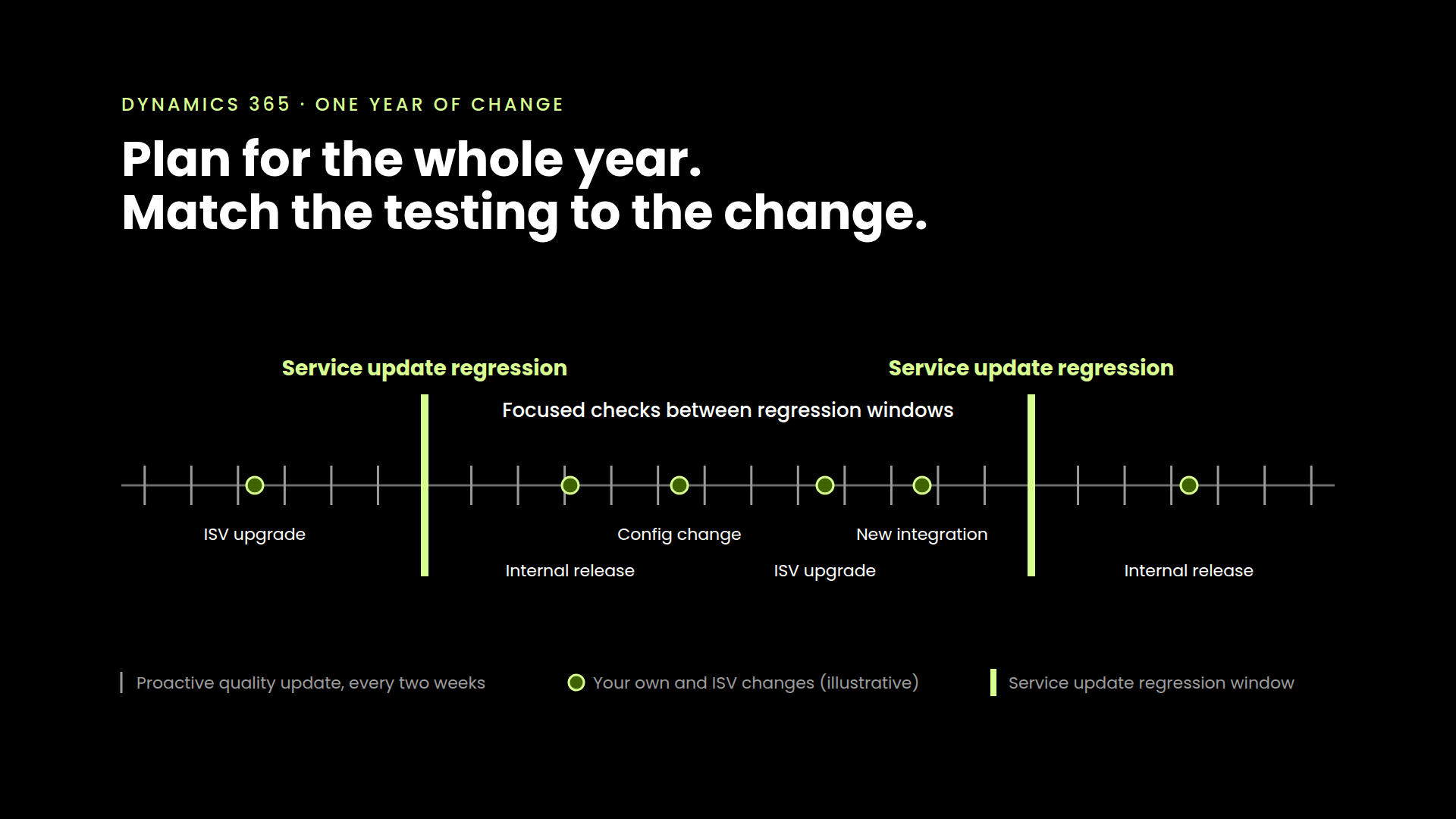
Download the Dynamics 365 Finance & Operations update calendar to plan ahead and align testing with Microsoft's release cadence.


See it in your environment, today.
Real test scenarios. Real results. No sandbox demo.