
9 Common Myths About Automated Testing in Microsoft Dynamics 365
Automated testing is becoming essential for businesses using Microsoft Dynamics 365. But with growing interest comes a lot of misinformation. Misconceptions about cost, complexity, and who can use it often hold teams back from realizing the true value of test
Automated testing is becoming essential for businesses using Microsoft Dynamics 365. But with growing interest comes a lot of misinformation. Misconceptions about cost, complexity, and who can use it often hold teams back from realizing the true value of test automation.
In this blog post, we address nine common myths about automated testing and explain what the reality looks like for modern ERP environments like Microsoft Dynamics 365.
Myth 1: Automated Testing Costs Too Much
Reality: While there is an upfront investment, the long-term savings are significant. According to Forbes, IT downtime can cost as much as $9,000 per minute. Avoiding even a single outage can quickly justify the cost of automation. The return on investment grows as more processes are automated and less time is spent on manual testing efforts.
Myth 2: Automated Tests Do Not Require Maintenance
Reality: Test automation is not a one-time setup. As Dynamics 365 continues to evolve, your test scripts need to evolve with it. TheTestMart handles platform-level changes by automatically updating your scripts after each Microsoft release.
Myth 3: If You Automate Testing You Do Not Need Manual Testing
Reality: Automated and manual testing both have important roles to play. Automation is great for repetitive tasks and regression testing, while manual testing is essential for exploratory scenarios and usability evaluation. A complete test strategy combines both approaches.
Myth 4: Automated Testing Is Only for Developers
Reality: You do not need to be a developer to use automated testing. Low-code and no-code platforms make it easy for business users, analysts, and QA professionals to contribute to testing without writing complex scripts.
Myth 5: You Must Automate Everything From the Start
Reality: The best approach is to start small and scale gradually. Begin with repeatable and high-impact test cases like login flows or core financial processes, then expand your automation over time.
Myth 6: Only Large Enterprises Can Use Test Automation
Reality: Test automation is accessible to businesses of all sizes. Small and medium-sized teams can benefit just as much, especially when using no-code solutions that reduce the need for specialized staff.
Myth 7: Test Automation Is Too Rigid to Handle Change
Reality: With modern tools, automated testing is flexible and designed to keep pace with change. Platforms like TheTestMart make it easy to adapt tests as your D365 environment grows and changes.
Myth 8: Manual Testing Is Good Enough for Dynamics 365
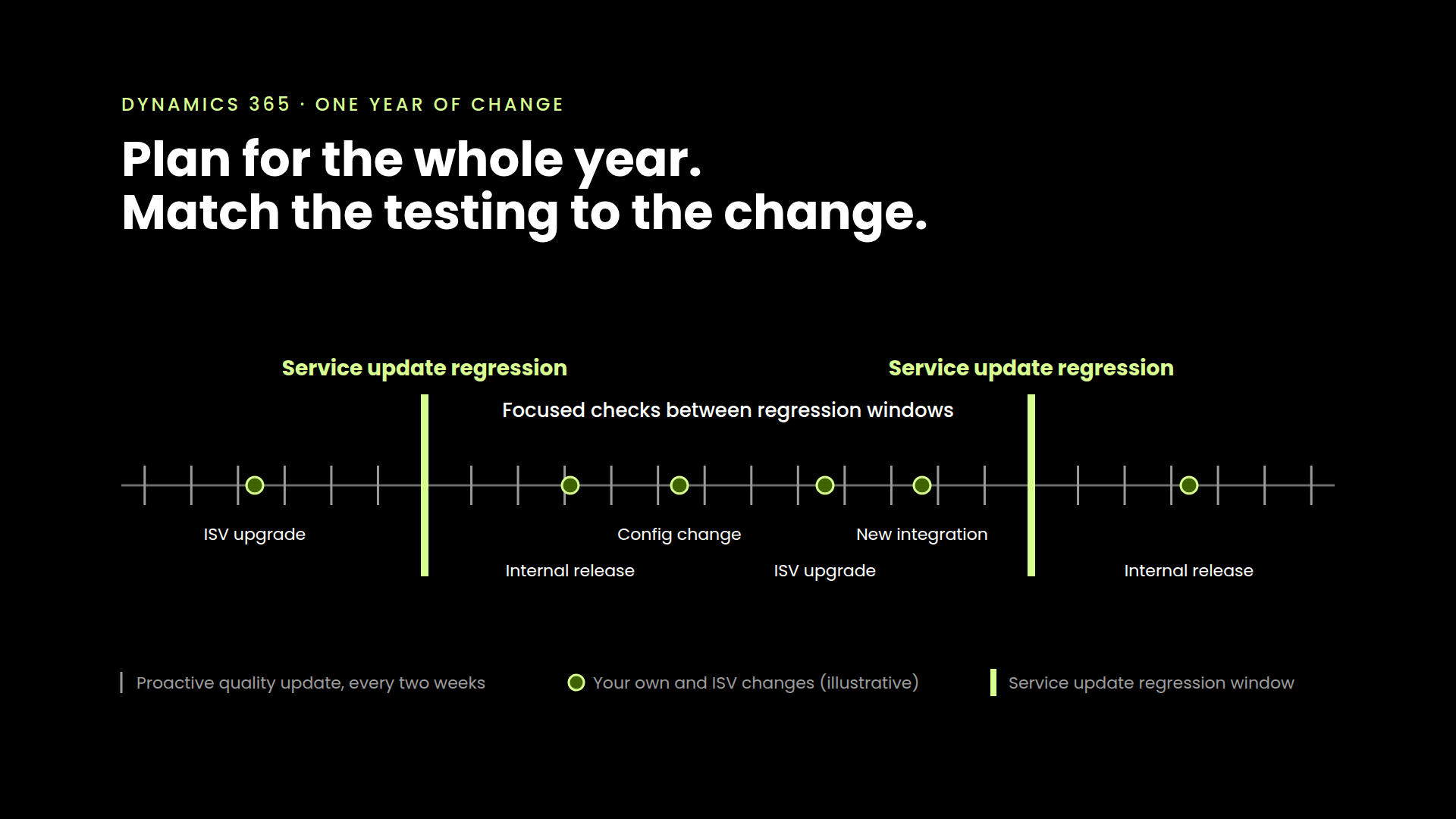
Reality: Monthly updates from Microsoft and the need for speed make manual testing alone insufficient. It is slow, prone to errors, and hard to scale. Automated testing provides the most scalable and reliable way to maintain coverage and confidence in fast-moving ERP environments.
Myth 9: Automation Replaces the QA Team
Reality: Automation does not replace QA professionals. It frees them from repetitive tasks so they can focus on more strategic work like risk analysis and exploratory testing.
Final Thoughts
Getting the most out of automated testing starts with understanding what it is and what it is not. By moving past these nine myths, your team can build a smarter, more sustainable approach to testing in Dynamics 365.
Get in touch today to learn more about how TheTestMart can transform your Dynamics 365 testing.


See it in your environment, today.
Real test scenarios. Real results. No sandbox demo.